Online Drawing Course
4501: Drawing I
Learn to draw and communicate what you see
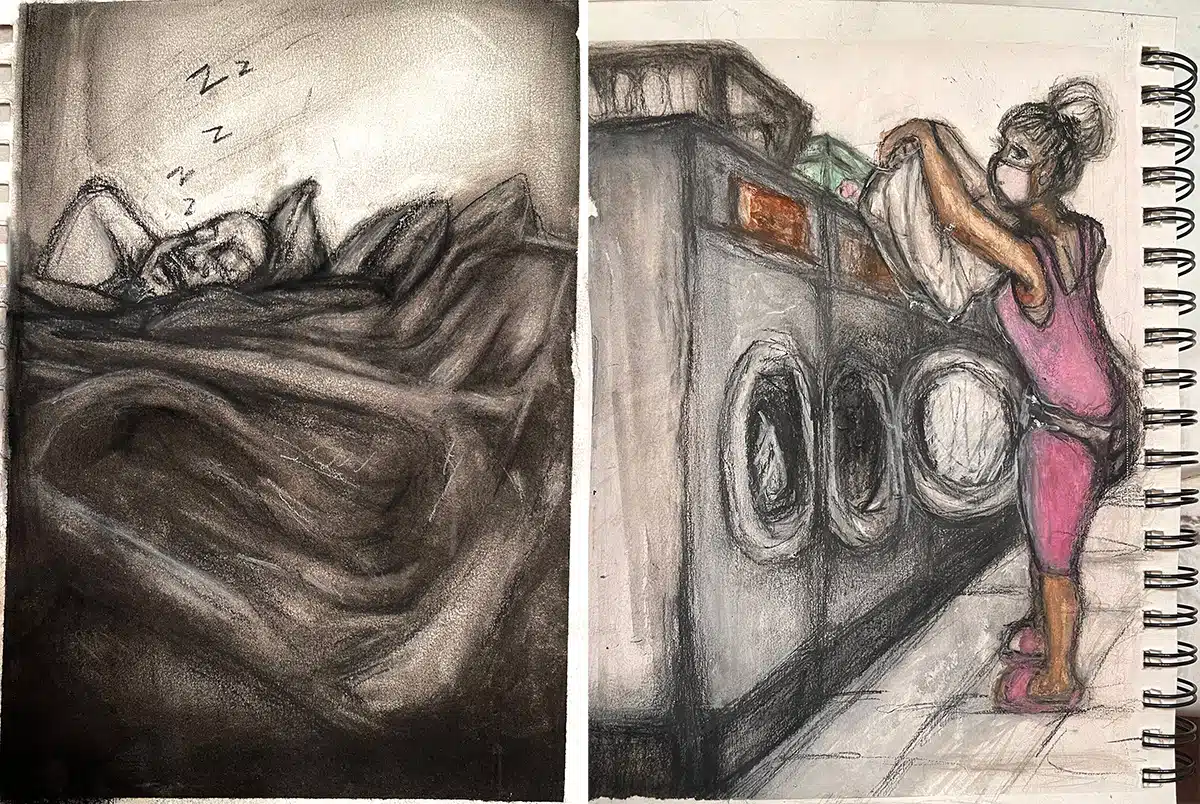
Many people are afraid to draw, but the truth is that drawing is not as hard as it seems. If you can relax, get your mind around the task, and begin to understand what you see, you can draw. In this online drawing course, you'll learn how to analyze what you see in the world around you and communicate it on paper. Guided by a professional artist, you will explore the critical concepts of line, mass, form, perspective, value, and composition, building a solid foundation for all your art and design work.
About This Course
Project-Based Learning
Creative projects range from technical explorations of line and form, 1 and 2-point perspective, to still life drawings exploring positive and negative space, complex forms, and the naturalistic use of lighting.
What Skills Will I Develop?
Students in this course can expect to learn to:
- Build a foundation in drawing skills by creating a wide range of still life drawings.
- Develop best practices for drawing by setting up lighting and choosing and handling materials appropriately.
- Identify and represent in drawing the basic elements of form (line, plane, mass) and the fundamental geometrical shapes of subjects.
- Employ both gesture and contour drawings to capture the mass and structural lines in drawing subjects.
- Make use of measuring points and thumb measures to keep the different areas of a drawing in perspective.
- Apply approaches to creating the illusion of depth or effective composition.
- Examine the effects of lighting location, angle, and direction, in creating shadow and value contrast in drawing subjects.
- Separate a drawing into light and dark areas and represent the overall lighting using a cast shadow and shadow edge.
- Choose and represent in drawing six different levels of value: highlights, mid-tones, shadow edge, casting shadow, core shadow, and reflected light.
- Use charcoal, graphite, mixed materials, and ink wash to represent value in drawing.
- Experiment with basic color interactions and mixing techniques for use in drawing.
- Identify and apply stylistic approaches to drawing including photo-realism, photomontage, and abstract expressionism.
What Software and Supplies Do I Need?
- Computer with Internet connection.
- Basic drawing materials such as pencil, paper, charcoal, and easel. More detailed information on supplies available at course syllabus page.
- Access to a digital camera for photographing your artwork.
Course Instructor(s)
The course is taught by the following instructor(s):

Jordon Schranz is an audio/visual artist and designer whose work has been exhibited internationally in New York, Chicago, El Paso, Berlin, Bogotá, and Ciudad Juárez.
Course Outline
Learning to See
Drawing isn't as difficult as it first seems. In this course we will learn how to interpret what you see and translate it to paper. In the first week, you will explore the different types of drawings that you can create and the types of drawing materials you will need. We will examine compositional concepts for creating artwork and learn terms and concept for making marks.
Linear Perspective and Rectilinear Form
Perspective is a key area for any artist to master. This week we will learn about three tools artists use to create a sense of depth in a composition: overlapping, scale, and foreshortening. There will be a focus on important concepts in linear perspective: vantage point, eye level, and vanishing points. The class will learn how 1-, 2-, and 3-point perspective drawings are created.
Linear Perspective II, Elliptical Forms, Basic Forms
Perspective will continue to be a focus in this week's lesson, where we will learn how to multiply and divide rectilinear shapes or forms and explore hard and easy ways to draw circles and examine how to draw an ellipse in 1- and 2-point perspectives.
Complex Forms and Drawing From Observation
In this week's class we will broaden our scope to explore how to draw geometric forms and objects with complex forms. To unpack this topic, we will utilize different techniques to create a drawing, including locating eye-level, triangulation, and gesture drawing. Areas of exploration will include guide lines, measuring points, enveloping, plumb lines, and checking proportions.
Volume, Shadows, Notan
The proper use of value is essential to representing the mass of any drawing subject. The week we will explore how value is used to show the light and dark parts of an object. We will examine how the location of the light source affects on the shape of the shadow and how various effects can be created based on the placement of your light source. A special topic will be how to create a Notan, a Japanese composition that uses a distribution of light and dark.
Value and Working With Charcoal
Our final lecture will deepen our understanding of value in drawing. We will look at how to create and use a value range and value scale and learn the difference between high contrast and low contrast. We will examine all the components of a shadow cast by an object and discuss the technical aspects of drawing with charcoal.
Frequently Asked Questions (FAQ)
How Do The Courses Work?
Our Professional Certificate courses are project-based and instructor-led. In each course you’ll complete a series of lectures and projects designed to stretch your creative skills. The courses are delivered on a flexible schedule with no set-logins or Zoom meetings. You can study when you want, provided you complete your program by the assigned deadline.
Who Are The Instructors?
Our courses are developed and taught by our industry-leading faculty of creative professionals. This means that you’ll learn in-demand skills, get feedback on your work, and build a portfolio of creative work. View our Student Gallery for featured student projects.
When Can I Start?
You can enroll in this course on an individual basis or as part of a Professional Certificate program. Professional Certificate programs start every month on the first of the month. With rolling admissions, you can start as soon as you complete Orientation.
Explore Professional Certificate Programs: Graphic Design | Web Design | Multimedia | Digital Arts | Marketing Design | Fine Arts
How Do I Register?
To register for a Professional Certificate program, complete our program application. To register for this course on an individual basis, please contact our admissions team at admissions@sessions.edu. An Admissions Advisor will contact you to setup your enrollment.
| Course Tuition and Fees | |
|---|---|
| Tuition | $949 |
| Registration Fee* | $50 |
| Total Course Price | $999 |
Registration fees are nonrefundable after 5 days from enrollment.
Is Sessions College Accredited?
Yes. Since 2001, Sessions College has been accredited by the Distance Education Accrediting Commission (DEAC). The Distance Education Accrediting Commission is listed by the U.S. Department of Education as a recognized accrediting agency and is recognized by the Council for Higher Education Accreditation (CHEA).